Exalto Capture
SDK and service
Exalto Capture
What it is
The flight recorder for your AI work
Overview
001

Sometimes the exchange itself is the evidence.

Exalto Capture · You capture. A third party seals. Anyone can verify.

What an agent did, what a chatbot told you, what a paid API returned. Capture it on your side as it happens. Seal it. Anyone can verify.

Verify a trace ↗

Open source · SDKs for Python, Node.js and Rust

Fig. 01An eval run, on the record.Example trace replay · 15 Oct 2026
~/evalszshREC
$grep -n CaptureTransport run_eval.py
14 CaptureTransport(client, mode="notarized", key=key, on_artifact=keep)
$python run_eval.py --suite reasoning-50 --model gpt-5
50/50 items · 43 correct · 50 captures kept, encrypted under your key
$grep "Item 37" runs/reasoning-50.log
item 37 trc-8f3k2q openai gpt-5 200 14:03:52 captured
$python seal.py captures/trc-8f3k2q.llmcapture
client.notarize · TLSNotary proof with Exalto · trc-8f3k2q.llmtrace
$python verify.py trc-8f3k2q.llmtrace
✓evidence notarized · TLSNotary proof
✓provenance api.openai.com over authenticated TLS
✓integrity package hashes match
✓time witnessed by Exalto at 14:03:52 UTC
$
Sealed traceVerified · Notarized
trc-8f3k2q
reasoning-50 · Item 37 · openai · gpt-5
Provenanceapi.openai.com · authenticated TLS✓
Integritysha256 9c41…e07b · 6 entries✓
Time14:03:52 UTC · Exalto✓
DisclosedRequest and response bodiesHiddenEvery header value, your API key includedNotaryExalto · key 02a7…c41e

Verified against the public key of Exalto’s notary. Anyone can verify.

capture.exalto.ai/s/trc-8f3k2q

A benchmark run through the Python SDK. The harness keeps its API key, every exchange comes back as an encrypted capture you store, and the one you cite gets sealed.

Log 002The flight recorder#recorder

Exalto Capture is the flight recorder for your AI work. Add the SDK to your code, keep calling OpenAI or Anthropic as before, and every call is witnessed by a third-party "notary" you choose, such as Exalto’s. Each one comes back to you as a file you store wherever you like. Nobody looks at it in normal operation. When something needs proof, seal the trace and hand it to anyone. Until that day, a Notarized capture is encrypted under a key only you hold, and the notary never received what is inside.

Who it is for
Developers who ship agents, run evals, route models or sell tool calls, and anyone who wants a record of their AI work that other people can verify.
Why now
As agents take on more of the work, customers, reviewers, auditors and counterparties will ask how a result was produced. Exalto Capture makes that evidence simple to keep, share and verify, whether you ship agents or sign off on their work.
Pricing
The SDKs and verifying are free. Exalto’s notary meters capture and sealing, with a small allowance free each month; your own notary costs nothing.
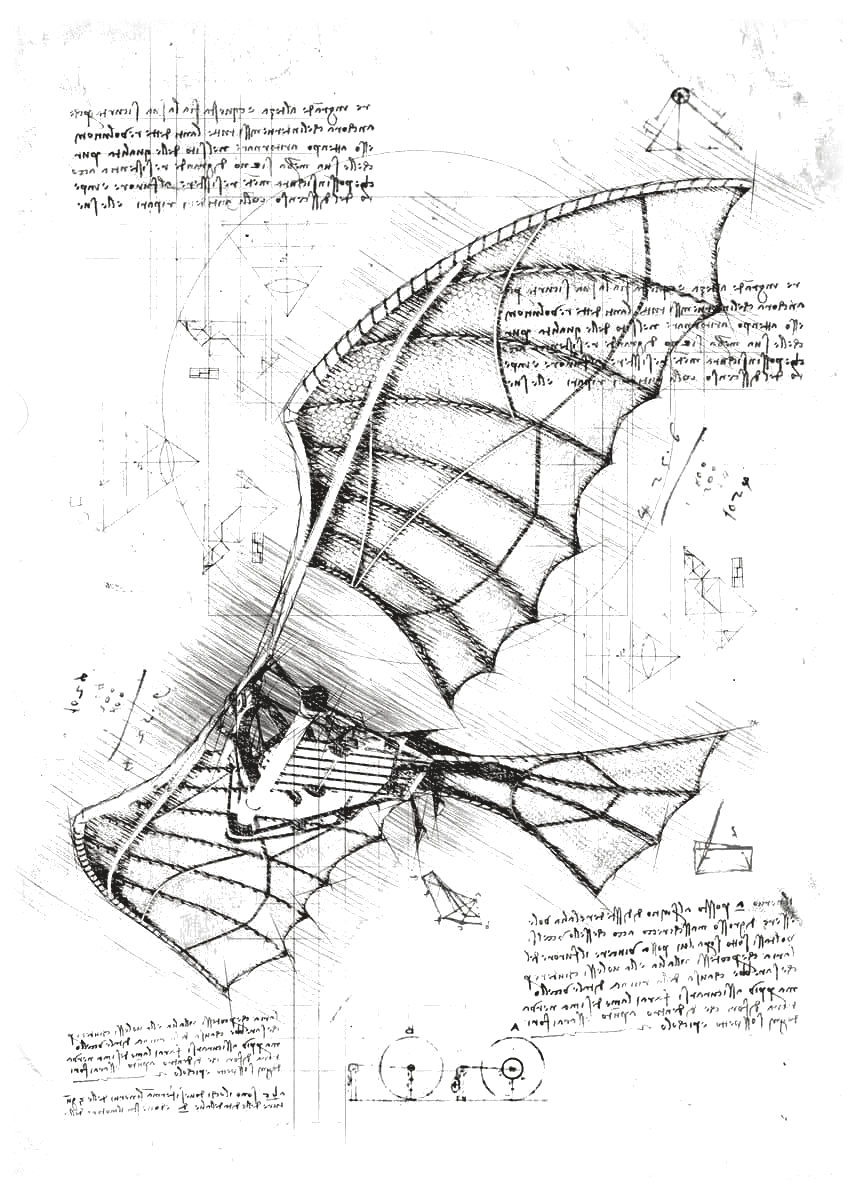
FIG. 260Instructions62Responses64Tool calls66TimeDesign for a flying machine, after Leonardo
Log 003How it works#how-it-works

A transcript or screenshot can be edited. A Notarized trace is actual proof.

Anyone can edit a transcript or alter a screenshot. That’s why “here’s what the AI said” cannot be trusted.

Your session already runs over an encrypted, authenticated connection to the AI provider. The protocol relays that session through an independent "notary", such as Exalto’s, that witnesses exactly what crossed the wire without ever being able to read it. Using multiparty TLS, your process and the notary split the session keys so the notary co-signs the encrypted traffic in real time without holding the decryption key, and when you selectively disclose an exchange later, the math proves it came from the provider while your API keys and unshared work stay out of the notary’s sight. Old cryptography, pointed at a pressing new problem.

01 Start a session02 Witness, never read03 Answer as usual04 Verify, anywhere70727476YouThe notaryThe AI providerAnyoneExalto Capture SDK,in your processExalto, orone you runapi.openai.com,api.anthropic.comcapture.exalto.ai,or offlineholds: key, plaintextholds: one key shareserves: TLS, as usualneeds: notary keyOne authenticated TLS session. The notary co-signs ciphertext only.Later, you hand over the sealed trace. Only what you disclose travels.
FIG. 370You72The notary74The AI provider76AnyoneMultiparty TLS, built on TLSNotary
A Notarized trace establishes

Provenance

It came from a specific AI provider.

Integrity

It hasn’t been altered.

Time

It existed by that moment.

In Notarized mode the notary, ours included, never receives your plaintext or your credentials: they stay in your process and go only to the provider, and the private checkpoint is encrypted under your key, wherever you store it. The cryptography is TLSNotary, open source. Witnessed mode is the exception you opt into: the notary sees the exchange so it can vouch for it, and its seal is the notary operator’s word, not a proof. More in the spec.

Fig. 04Disclose the exchange you want to share. Keep the rest.Interactive · reasoning-50
Your archive · 50 exchanges3 disclosed · 47 private
DisclosedPrivateSelected

Click an exchange to disclose and inspect it; click it again to keep it private. The notary saw ciphertext for all fifty. Disclosing three reveals three.

Item 37 · reasoning-50Disclosed
trc-8f3k2q
Request · request.disclosed.http
POST /v1/responses HTTP/1.1
host:
authorization:
content-type:
{"model":"gpt-5","input":"Item 37. What is 49 × 8?"}
Response · response.disclosed.http
HTTP/1.1 200 OK
content-type:
transfer-encoding: chunked
{"output_text":"392"}
Provenanceapi.openai.com · authenticated TLS✓
Integritypackage hashes match✓
Time14:03:52 UTC · Exalto✓
verify trc-8f3k2q · passes

Header values are hidden in every sealed trace, so your API key never travels with it. Request and response bodies are what you can choose to disclose.

Log 004Quickstart#quickstart

From source to a sealed trace.

Keep the API key in your client and give it the SDK’s transport. The SDK runs in your process: it relays each call through the notary and hands its evidence back to your code, the private checkpoint encrypted under your key.

  1. 01

    Get the source

    Rust 1.95 and Python 3.10 or later. No packages are published yet; the quickstart builds from source, in Python or Node.js.

    $ git clone https://github.com/exalto-ai/capture-oss.git && cd capture-oss/sdk/python
  2. 02

    Build the SDK

    Builds the exalto_capture module, with its httpx2 transport, into a virtual environment.

    $ python3 -m venv .venv && .venv/bin/pip install maturin httpx2 && VIRTUAL_ENV="$PWD/.venv" .venv/bin/maturin develop --release
  3. 03

    Give your client the transport

    It keeps its API key and works as before. In Notarized mode the notary never receives your plaintext or credentials, and keep() gets each call’s .llmcapture, encrypted under your capture key, to store where you like.

    OpenAI(http_client=httpx2.Client(transport=CaptureTransport(client, mode="notarized", key=key, on_artifact=keep)))
  4. 04

    Seal the call

    When you need to prove it. Exalto’s notary runs the TLSNotary proof with your process, and your code gets back one portable .llmtrace package. Capture and sealing through Exalto’s notary draw on monthly allowances.

    trace = client.notarize(capture, key)
  5. 05

    Verify it

    Offline, or at capture.exalto.ai/verify. Checks the notary evidence, the provider’s identity, the disclosed bytes and every hash. Anyone holding the package can.

    notary.verify(trace).evidence_kind # "notarized"

Node.js: give an OpenAI or Anthropic client fetch: createFetch(client, options). Claude Code, Codex and agents in CI record through hosted capture instead, where Exalto handles the plaintext and credentials. Both are in the SDK docs.

Log 005The components of the stack#components

The Exalto Capture Stack

Exalto Capture SDKs

The flight recorder, in your own code: Python, Node.js and Rust. Your OpenAI or Anthropic client keeps its key and works as before; each call comes back with its evidence as bytes you store. Capture, seal and verify from your products, services and agents. Open source, built from source for now. The docs.

Developers, routers, eval and security teams

Exalto’s hosted capture

For agents you can’t change, such as Claude Code and Codex, or ones in CI and the cloud: point them at Exalto’s gateway and every call is recorded for your organization. Exalto then handles the plaintext and provider credentials, in every mode. The docs.

Teams running Claude Code, Codex or agents in CI

Exalto’s hosted "notary"

Binds a trace to the provider, the time and the content, so anyone can verify it later. Share a link, and anyone can verify it too. The third party that countersigns and timestamps, and in Notarized mode never sees plaintext. Witnessed mode trades that privacy for cheap sealing of any size: the notary relays the exchange and vouches for it, on its operator’s word rather than a proof. It meters capture and sealing; sealed traces and docs live at capture.exalto.ai.

Everyone

The Exalto Capture Protocol (ECP)

The open protocol underneath all of it. Use Exalto’s notary or run your own.

Operators of compatible notaries; builders

An open protocol. A choice of who to seal with.

One open standard at the base. Tools, notaries, and apps stack on top. Exalto’s notary is just one among many: seal with ours, with a third party’s, or with one you run for your organization.

Yours to build.

Sealed traces are a new primitive. The spec, the OpenTelemetry trace format, and the verifier are open.

→ build on the protocol
Fig. 05Inside a sealed trace..llmtrace · six entries, in order
trc-8f3k2q.llmtrace
├── archive-manifest.json80The formats, then the path, size and SHA-256 of every entry.
├── evidence.tlsn82The TLSNotary presentation, the notary’s signature and the provider’s TLS identity.
├── manifest.json84The trace ID, the authenticated provider and host, the connection time and the notary key.
├── request.disclosed.http86What was sent: the request line, header names and body. Every header value is hidden.
├── response.disclosed.http88What came back: output, usage and tool calls, as the provider sent them.
└── trace.otlp.json90The same exchange as a canonical OpenTelemetry trace.
Log 006Applications#applications

Sealed traces lower the cost of verification.

Cheap verification changes behavior and increases trust.

01

Traces for AI R&D, evaluation and investigation

Give others evidence they can verify.

Researchers, builders and independent evaluators need to rely on traces from work they did not run themselves.

Exalto Capture lets you capture and seal model requests and responses. Share the relevant run without opening your entire archive. Anyone can verify the origin and integrity of the disclosed exchanges.

Back a benchmark result with the model, prompts and responses behind it. Publish an agent paper with traces reviewers can inspect. Give an outside investigator verifiable exchanges from a disputed run.

In cybersecurity, this is how defenders learn: the instructions a model received, the responses it produced, the tool calls it requested. Sealed, those records can go to other teams without asking them to trust the source.
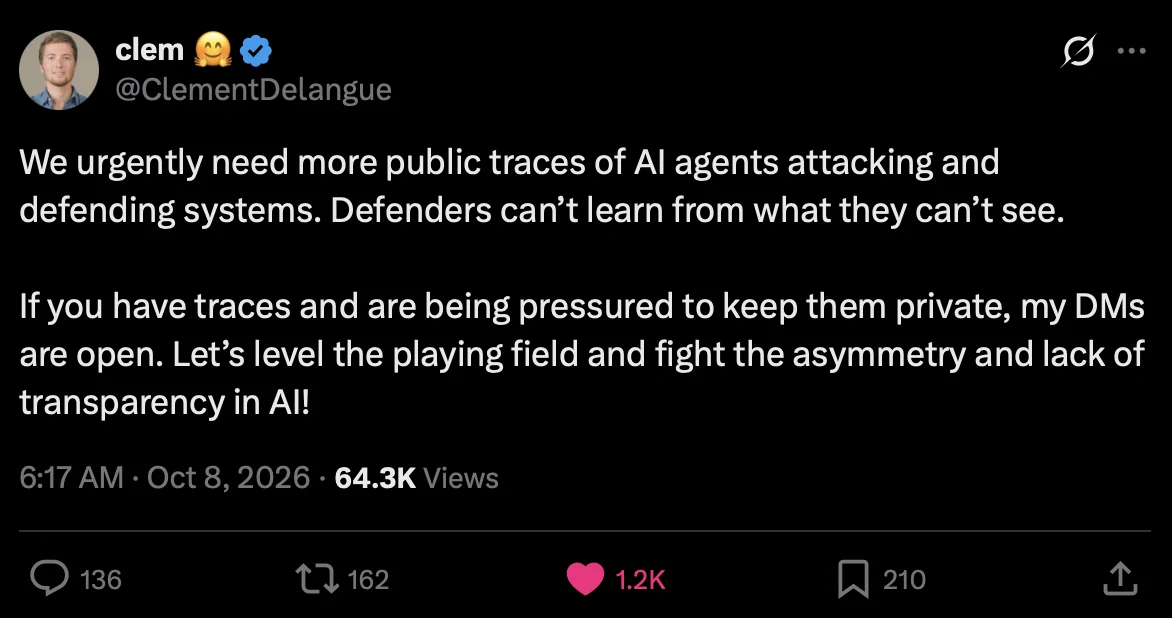
Post by clem (@ClementDelangue) on X, 8 Oct 2026: We urgently need more public traces of AI agents attacking and defending systems. Defenders can’t learn from what they can’t see. If you have traces and are being pressured to keep them private, my DMs are open. Let’s level the playing field and fight the asymmetry and lack of transparency in AI!
x.com/ClementDelangue/status/2108184948548976921 ↗
Commit, then verify

Commit to the record before an incident. Verify it afterward.

Publish a commitment to a defined set of traces on a regular schedule. Investigators can later check the disclosed records against that commitment and spot anything changed or missing from the committed set.

The labs currently control disclosure. Reviewers can independently check whether the disclosed evidence matches the earlier commitment.

02

Receipts for model routing and agentic commerce

Receipts for what was served and what was delivered.

Customers choose a provider and model configuration. Routers can use Exalto to seal the upstream exchange and link it to the customer’s request. The proof ties the response, including any reported configuration, to the provider’s authenticated endpoint.

When an agent pays for a tool call over x402 or MPP, give both sides verifiable evidence of what came back. Seal the request and response, then link the dated exchange to the payment receipt. Buyers and sellers now have a record they can use in a dispute.

The same applies to a shopping agent acting on a user’s mandate: connect the authorization, merchant terms and order confirmation to show what was approved, what was ordered and what was confirmed.

03

The audited commit

Provenance per commit, checkable by anyone with access.

A pull request lands with a coding agent behind it. Change controls already require proof that someone reviewed it; with agents writing the code, the proof has to show what the human checked. The developer seals the session and links it from the commit: what the agent was asked, what it changed, what the developer verified. Provenance per commit, checkable by anyone with access. The same record answers a regulator or third-party years later, across every commit rather than a sample.

Works with Codex and Claude Code today, through hosted capture.

More usesthe published evalprompt-injection forensics
Log 007Trust model#trust

One trace proves what happened. Capture enforced across an organization also proves what didn’t.

A sealed trace proves
It cannot prove

The disclosed bytes traveled an authenticated connection with the named AI provider.

On its own, that every interaction was disclosed. With capture enforced across an organization, it can.

They have not changed since capture.

Who was behind the keyboard.

The named "notary" service witnessed them at the stated time.

On its own, that no other AI or device was used. Enforced capture closes that gap too.

The exact timeline as it actually unfolded.

That an output was correct, lawful, or wise.

A trace covers the interactions you capture, and for most uses that is what matters. Where completeness matters, enforce capture across the organization: then the record also shows what never happened. A Notarized trace proves its provider connection with TLSNotary; for a Witnessed trace, that rests on the notary operator’s word.

Learn more: full trust model

Log 008For agents#agents

Hand this to your agent.

Paste it into Claude Code, Codex, or any agent that works on your code. It builds the SDK, gives your provider client its transport, and asks you where to keep the capture key. It asks again before it seals or shares anything.

Prompt
Add Exalto Capture to this project's OpenAI or Anthropic client. Read https://capture.exalto.ai/docs/sdk.md first.Build the Python or Node.js SDK from source: https://github.com/exalto-ai/capture-oss/tree/main/sdkUse Notarized mode, and store each artifact where I tell you.Ask me where to keep the capture key. Never print, log or commit it, or any .llmcapture file.Ask me before you seal a capture or share a trace.
capture.exalto.ai/llms.txt

This page, written for agents: what Capture does, the trust boundary, install, and the package layout.

capture.exalto.ai/docs.md

Every page has a markdown twin. Add .md to the address.

capture.exalto.ai/docs/sdk

The SDK: the modes, the transports, keeping the capture key, sealing later and verifying, and what the notary sees in each mode.

Log 009Powered by Capture#undertext

Undertext.

A scratchpad for thinking and editing with AI that shows what you contributed and what the model did. Every scratchpad has a flight recorder underneath; its seals come from Exalto’s notary.

→ undertext.net
Captured by
You
Sealed by
Exalto
Verified by
Anyone

Capture.Seal.Verify.